ICT vs. Flying Probe: Cost-Per-Board Comparison
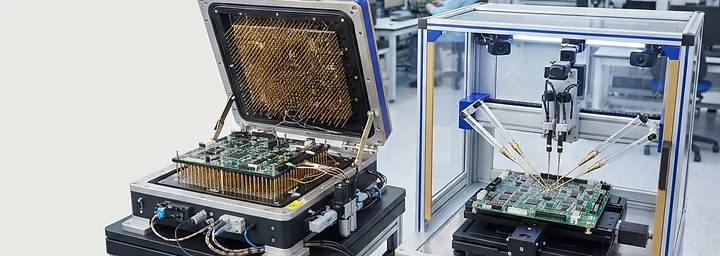
Fixture cost versus test time — the arithmetic behind choosing between bed-of-nails ICT and flying probe, with a worked break-even example.
ICT vs. Flying Probe: Cost-Per-Board Comparison
The question is usually framed as a technology choice. It is really an arithmetic one, and the arithmetic has a clear crossover point.
ICT carries a large fixed cost — fixture and program — and a very small per-board cost. Flying probe carries almost no fixed cost and a large per-board cost. Which is cheaper depends on one number: how many boards you will actually test on that design.
The two cost structures
ICT. You pay once for a mechanical fixture and once for test program development. After that, each board is tested in seconds by a dedicated machine.
Flying probe. No fixture. The machine touches nets sequentially with a small number of moving probes, so the per-board test time is far longer, but there is nothing to build and nothing to store.
The shapes are opposite. One front-loads cost, the other spreads it across every board forever.
Worked example
Numbers below are illustrative — substitute your own quotes and machine rates. The method is what matters.
Assumptions:
| | ICT | Flying probe | |---|---|---| | One-time cost (fixture + program) | $25,000 | $0 | | Test time per board | 30 seconds | 8 minutes | | Machine rate | $60/hour | $60/hour |
Per-board cost at various volumes:
| Annual volume | ICT (amortised + test time) | Flying probe | Cheaper | |---|---|---|---| | 100 | $250.50 | $8.00 | Flying probe | | 500 | $50.50 | $8.00 | Flying probe | | 1,000 | $25.50 | $8.00 | Flying probe | | 3,333 | $7.50 + $0.50 = $8.00 | $8.00 | Break-even | | 5,000 | $5.00 + $0.50 = $5.50 | $8.00 | ICT | | 20,000 | $1.25 + $0.50 = $1.75 | $8.00 | ICT |
The break-even formula:
N = one-time cost / (FP test cost per board − ICT test cost per board)
N = $25,000 / ($8.00 − $0.50)
N = 3,333 boards
Below roughly 3,300 boards on that design, flying probe wins. Above it, ICT wins and keeps winning as volume grows.
What the arithmetic leaves out
The crossover is a starting point, not the answer. Several factors move it significantly:
Fixture lifetime across revisions. A fixture can often be modified for a board revision rather than rebuilt, which spreads the fixed cost across more boards than one design alone. That lowers the break-even volume considerably.
Program development is not always separate. If you are already paying for program development on an existing platform, the incremental cost of an ICT path may be much lower than a from-scratch quote suggests.
Flying probe supports multiple designs simultaneously. It needs no fixture, so the same machine serves every board you build. For high-mix low-volume production, that flexibility has real value that per-board arithmetic does not capture, because you avoid building a fixture per design.
Test time on complex boards. The ratio between ICT and flying probe test time is not fixed. Boards with very high node counts push flying probe time up sharply, moving the crossover down.
Rework and fault isolation. Flying probe diagnosis can be slower to interpret because measurements are sequential. ICT gives faster, more precise fault callouts on volume lines.
Floor space and capital. A tester is a capital asset that depreciates whether or not it runs. Flying probe cost is largely variable, which suits uncertain demand.
When the choice is not a choice
Prototype and NPI. Flying probe, almost always. A fixture for a board you will build twenty of never amortises.
High-mix low-volume. Flying probe or a shared fixture strategy. Building a fixture per design is where fixture costs quietly multiply.
Stable high-volume production. ICT. This is the regime it was designed for.
Boards with no room for a fixture. Flying probe, or boundary scan for the inaccessible nets.
Boards needing powered functional coverage. ICT usually, since the fixture also provides the power and stimulus interface.
The hybrid most manufacturers use
In practice, mature operations rarely pick one:
- Flying probe for prototypes, engineering builds, and low-volume variants.
- ICT for the high-volume production design once volume justifies the fixture.
- Boundary scan for the joints neither can reach.
The decision then becomes not "which machine" but "which stage of the product lifecycle is this board in."
The number to actually calculate
Take your annual volume for that specific design. Get a real fixture-plus-program quote. Get the ICT test time from the vendor, and the flying probe time from whoever runs the machine. Multiply by your loaded machine rate.
Then ask one further question: how many board revisions will this fixture survive?
That question moves the answer more than anything else in the table.
Browse ICT service providers for both fixture-based and flying probe capability, or compare flying probe platforms in the directory.
Related in the directory: flying probe test providers, Keysight 3070 test houses, used and refurbished ICT equipment and the full ICT vendor directory.