What Does an ICT Fixture Actually Cost in 2026?
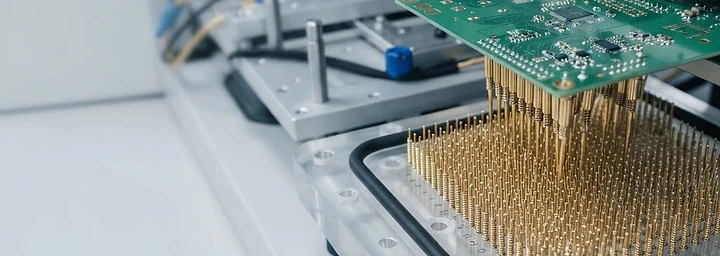
Fixture cost is the most-asked and least-answered question in ICT procurement. Here is what actually drives the number, and the line items most quotes leave out.
What Does an ICT Fixture Actually Cost in 2026?
Ask five fixture houses to quote the same board and you will get five different numbers, often spread across a factor of three. That spread is not dishonesty — it reflects genuinely different interpretations of scope. Understanding which variables drive the price is the difference between comparing quotes and comparing numbers.
Why fixture quotes vary so much
A fixture is a custom mechanical assembly built to one specific board. There is no catalogue price, because no two boards present the same combination of probe count, access geometry, actuation force, and mechanical complexity. A quote for "a fixture" can reasonably mean a bare mechanical assembly, or a complete turnkey package with program development, first-article correlation, and documentation.
Before comparing two quotes, confirm both cover the same scope. Most apparent price differences collapse once scope is normalised.
The cost drivers that actually matter
Probe count. This is the dominant variable. Every test point needs a receptacle, a spring probe, and a drilled location. Doubling the probe count roughly doubles the probe hardware cost and meaningfully increases the drilling, wiring, and assembly labour.
Actuation type. Vacuum fixtures use a sealed chamber and a vacuum generator to pull the board down onto the probe field. Press-fit and mechanical fixtures use a lever or pneumatic press. Vacuum is generally simpler for small and medium boards; mechanical actuation often wins on large boards, high probe force requirements, or where shop air and vacuum routing are awkward.
One-sided versus two-sided. Single-sided fixtures probe one face. Double-sided fixtures contact both faces simultaneously, roughly doubling the mechanical assembly, probe hardware, and the engineering to keep both sides aligned through the actuation stroke.
Mechanical complexity. Fine-pitch boards need tighter probe placement tolerance and often guided or dual-stage probing. High-current nets need heavier probes and different wiring. RF and high-speed nets impose impedance constraints that change the whole interconnect strategy. Each of these adds engineering time, not just hardware.
Whether program development is included. A fixture quote and a turnkey package are different products. Program development, debug, and correlation against a known-good board can be a substantial fraction of the total — and it is the portion most often omitted from a fixture-only quote.
Indicative ranges
Treat these as orientation, not a quotation. They exist so you can sanity-check a number, not to budget from.
| Configuration | Typical quoted range | |---|---| | Single-sided bed-of-nails, moderate probe count | roughly $8,000 – $25,000 | | Double-sided, high probe count, fine-pitch | above that range, often substantially | | Used fixture, adapted to a new board | a fraction of new, plus rework and re-probing | | Program development added to any of the above | additional, scoped separately |
The range is wide because the variables are wide. A 400-probe single-sided fixture for a through-hole board and a 3,000-probe double-sided fixture for a fine-pitch assembly are not the same product at different prices — they are different engineering problems.
What quotes usually leave out
- First-article correlation — verifying the fixture on a known-good board and reconciling any probe or program discrepancies.
- Probe replacement consumables — probes wear and need periodic replacement; the rate depends on force, board finish, and actuation count.
- Engineering change iterations — ECOs during the build cycle may require fixture modification, quoted separately or not at all.
- Shipping and crating — fixtures are heavy and awkward; freight is real money.
- Program portability work — if the program must run on more than one platform, that is additional scope.
Ask explicitly which of these are included. A quote with the gaps filled in is worth more than a lower quote with undefined edges.
Reducing cost without wrecking coverage
Design for test earlier. Test-point access defined at layout time costs nothing. Retrofitting access after layout means either a more complex fixture or lost coverage. The cheapest fixture is the one the design makes possible.
Right-size the probe field. Every probe adds cost. Probes on nets that will never fail in a way ICT can detect are spending money on nothing. Prioritise nets by failure mode.
Use flying probe where volume is low. For prototypes and low-volume high-mix production, a fixture may never amortise. Flying probe needs no fixture at all.
Consider boundary scan for inaccessible nets. Where a net has no probe access at all — under a BGA, for instance — boundary scan may cover it without adding fixture complexity. See our comparison of boundary scan and traditional ICT for BGA and fine-pitch packages.
Buy used deliberately. Used fixtures can be a genuine saving, but only where the mechanical assembly can be re-probed and re-engineered for your board. Budget the rework honestly.
The practical approach
Get two or three quotes against an identical, written scope. Specify probe count, actuation type, sidedness, whether program development is included, and whether first-article correlation is in scope. Then compare.
If a quote is dramatically lower than the others, the useful question is not "why is this one cheap" but "what is not in it."
Browse ICT fixture and accessory suppliers in the directory to start sourcing, or submit a request and let vendors respond to a defined scope.
Related in the directory: bed-of-nails fixture builders, ICT fixtures and accessories vendors, Keysight 3070 test houses and used and refurbished ICT equipment.